There are villages that look lovely in photographs.
And there are villages that actually work as places to live.
Toddington manages a bit of both.
It has the village green, historic buildings, countryside and the sort of local stories that have been passed down through generations. But it also has schools, shops, clubs, places to eat and drink, community events and practical connections to the surrounding towns and motorway network.
Most importantly, it feels lived in.
And that's something you can't really measure on a property portal.
Toddington has been around rather longer than Rightmove
Toddington's history goes back centuries.
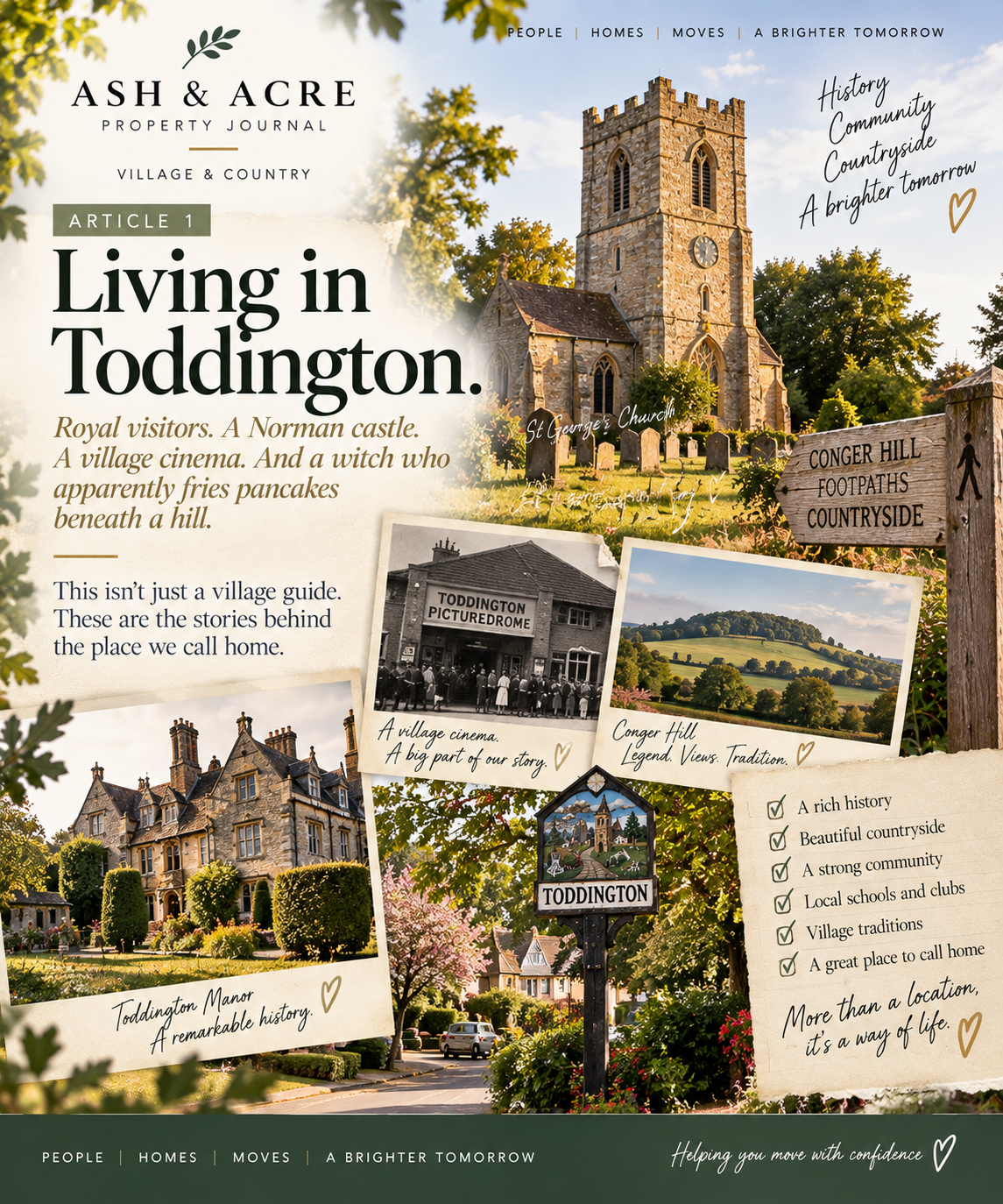
The village appears in the Domesday Book, received its first market and fair in the early 13th century, and St George's Church was consecrated in 1222. Queen Elizabeth I even visited Toddington Manor in 1563.
But one of our favourite pieces of Toddington history is much stranger.
The witch beneath Conger Hill
If you're new to the village, Conger Hill might simply look like an unusual mound near the church.
It is actually the remains of a Norman motte-and-bailey castle and is protected as a Scheduled Monument.
And then there's the witch.
For generations, Toddington children had a Shrove Tuesday tradition of going to Conger Hill, putting their ears to the ground and listening for the sound of a witch frying her pancakes beneath the hill.
Yes.
A witch frying pancakes.
We did promise you proper local knowledge. 😂
This isn't something we've picked up from village gossip, either. Historic England records the Shrove Tuesday custom, while Bedfordshire Archives says the tradition continued into the 1970s.
It's wonderfully odd.
And exactly the sort of thing that gives an old village its personality.
A village that has changed — without losing all of its past
Toddington today is very different from the village previous generations knew.
Fields have become homes. New estates have appeared. Businesses have changed. The village has grown and will continue to change.
That isn't just an impression. Central Bedfordshire's planning information identifies significant housing allocations at Alma Farm and land east of Leighton Road, while the council's latest community-governance work forecasts further growth towards 2030.
Toddington is also developing its own Neighbourhood Plan. A 2025 housing-needs survey, published in April 2026, found demand for both market and affordable housing, with particular interest in smaller houses and bungalows.
For us, that's an important part of understanding the local property market.
A village isn't frozen in time.
The challenge is allowing it to evolve while retaining the things that made people want to live there in the first place.
Toddington Manor — one of the village’s biggest stories
Toddington Manor isn’t simply a landmark on the edge of the village.
Its history reaches back centuries.
A major Tudor manor house was built there around 1560 by Henry Cheney, and in 1563 Queen Elizabeth I visited Toddington and knighted him. King James I later visited the estate too.
The original house was far grander than the building people know today — Bedfordshire Archives describes a substantial mansion built around a central court, with tall turrets and extensive service buildings. Over time, though, debt and neglect took their toll and much of the Elizabethan house was demolished in the 18th century. Parts of the surviving structure were later incorporated into the manor house that followed.
For local families, though, Toddington Manor is more than a history-book entry.
It has long been part of the landscape around the village, and older residents remember its grounds being associated with summer fêtes and horse shows. Today, the surrounding countryside also forms part of some lovely local walking routes — another reason the area feels so connected to the landscape beyond the village streets.
One little building with quite a story
On Conger Lane you'll find TADS Theatre.
And the building has had rather more lives than you might expect.
It began as a Primitive Methodist chapel, later became a hall and then, in September 1925, opened as Toddington's own cinema.
It was originally called the Picturedrome, later becoming the Cozy and eventually the Rex.
The old cinema showed silent films in its early years — apparently with a tin tray being rattled to create the sound of thunder — before the arrival of sound equipment.
It finally closed as a cinema in 1958, subsequently became a church village hall and was bought by Toddington Amateur Dramatic Society in 1993. It survives today as TADS Theatre.
Imagine that.
A Bedfordshire village with its own little cinema nearly a century ago.
It's one of those pieces of local history you'd probably never discover from the property particulars.
Family life and schools
For families considering Toddington, education will naturally be part of the conversation.
Toddington has Toddington St George Church of England School and Parkfields Middle School, with Harlington Upper School serving the wider area. Current school information confirms the established links between the Toddington schools and Harlington. Harlington itself says that the majority of its pupils join from Parkfields Academy in Toddington and Arnold Academy in Barton-le-Clay.
And this is one subject where our knowledge isn't purely professional.
Aiden and his brother went through the Toddington schools before continuing their education at Harlington.
So when we're talking to a family considering moving here, we're not simply reading school names from a database.
We've done the school runs.
There is, however, an important distinction: past family experience isn't a guarantee of today's admissions arrangements. Catchments, admissions criteria and school structures can change, so we'd always encourage parents to check the current position directly with the relevant school and Central Bedfordshire Council.
That's the useful combination:
local experience, backed up with current information.
Amanda's local note: Crowbush & The Glebe
Dog walks.
Crowbush is one of our favourites — tucked away on the south-western edge of Toddington, with old fields, hedgerows and routes connecting into the surrounding countryside.
But it isn't the only option.
The Glebe is another familiar part of everyday Toddington life. Sitting on the southern edge of the village, it's nearly ten acres of open space and somewhere local dog owners will know well.
And depending on when you visit, you may find considerably more than Labradoodles there.
The Glebe is also one of the grounds used by Toddington Rovers Football Club, whose history in the community dates back to 1885. Some of its youth teams play their home matches there, so at weekends the space can swap dog walkers for football boots, families on the touchline and youngsters representing their village.
That's something we really like about Toddington.
The same patch of village can be somewhere you walk the dog on one day and somewhere families gather for grassroots football on another.
Lottie and Araya prefer it when nobody has a football.
Apparently it interferes with the sniffing. 😂🐾
And for those whose preferred outdoor activity involves considerably less running around, The Glebe is also home to local allotments — another part of village life that quietly brings people together.
So within this one corner of Toddington you've got dog walkers, grassroots football, families on the touchline and green-fingered residents tending their plots.
Football boots, muddy paws and home-grown courgettes.
That's village life. 😂🌱🐾
Walking around Toddington Manor
If you've got a dog, Toddington gives you more options than you might realise from simply driving through the village.
There's Crowbush, with its old fields, hedgerows and links into the surrounding countryside; The Glebe, where dog walkers share this little corner of village life with Toddington Rovers, families watching grassroots football and green-fingered residents tending their allotments; and some lovely countryside walking around the Toddington Manor area too.
These aren't necessarily places that appear in an estate agent's property particulars.
They're the places you discover once you actually live here.
And if you're moving to Toddington with a dog, knowing where you can head on a Sunday morning — muddy boots, Labradoodle and all — can be every bit as useful as knowing how far you are from the motorway.
Lottie and Araya have undertaken extensive field research on this subject.
Mostly field. Very little research. 😂🐾
Community matters
One of Toddington's strengths is that there are still plenty of reasons for people to come together.
There are clubs, sports, village activities and community spaces, and the current Neighbourhood Plan group has been actively engaging with local clubs and societies as part of its work.
Then there are the traditions you come to know by living here.
One local favourite is the annual bonfire and fireworks night at the Fire Station.
It's a great community evening and one of those occasions when you'll bump into people you know all over the village.
Unless, perhaps, you're Lottie or Araya.
For pet owners, fireworks night is rather less exciting. 😂🐾
It's a tiny example, but it's precisely what we mean when we talk about knowing an area.
Moving somewhere isn't just knowing where the nearest supermarket is.
It's knowing when the village comes together.
And occasionally knowing when to get the dogs home early.
What is it actually like to live in Toddington?
This is the question we'd rather answer.
Because “Does Toddington have good transport links?” is useful.
But:
“Would we be happy living here?”
is much more important.
Toddington suits people who like the idea of village life without feeling completely cut off from everything around them.
There is countryside close by, but you're not isolated.
There is history, but this isn't a preserved museum village.
There are long-established homes alongside much newer development.
There are families who have been connected to the village for generations and people who arrived six months ago.
That's part of its character.
Toddington feels like a working village rather than a picture-postcard version of one.
And what about the houses?
This is where Toddington gets particularly interesting from a property perspective.
There isn't really such a thing as “the Toddington house price.”
You can have two properties with the same number of bedrooms and very different values.
Why?
Because buyers aren't purchasing bedrooms in isolation.
They're buying the road.
The plot.
Parking.
Garden.
Condition.
Position.
Outlook.
Potential.
Proximity to the centre.
And sometimes something as simple as how a house feels when they walk through the door.
Toddington contains older character property, established residential roads, bungalows, family homes and much newer development.
That means comparable evidence matters — but so does understanding which properties buyers will actually compare with yours.
If you're selling in Toddington
Please don't assume that the agent giving you the highest valuation is automatically the one who understands your property best.
Ask them:
Why?
Why that price?
Which properties have you compared it with?
Who is the likely buyer?
What else will that buyer see at the same price?
What happens if the first two weeks don't produce the expected response?
A valuation should be supported by evidence and local understanding.
Because we're not interested in winning an instruction by giving somebody the biggest number.
We're interested in getting them moved.
If you're thinking of buying here
Start with the life you want rather than the house you think you need.
Walk around the village.
Drive your commute.
Try the school run.
Find the footpaths.
Visit at different times of day.
Stand outside the house for five minutes and listen.
If you've got a dog, try the walk.
If you've got children, investigate the schools properly.
And don't just ask:
“Do I like this house?”
Ask:
“Could we live our life here?”
Because you can change a kitchen.
You can decorate a bedroom.
You can landscape a garden.
You can't pick the house up and move it to another village.
The places, people and property behind the village
That's what we want our Ash & Acre Village Stories to be about.
Not:
Three reasons Toddington is a great place to live.
You can find hundreds of articles like that.
We'd rather tell you about the Norman castle hiding beneath Conger Hill.
The children who once listened for a pancake-frying witch.
The village that had its own cinema.
The tucked-away dog walk.
The schools our own family attended.
The annual community traditions.
And the houses, old and new, that make up Toddington today.
Because local property knowledge shouldn't begin and end with the sold prices.
You have to understand the place as well as the property.
Thinking about moving in or around Toddington?
Whether you're considering selling a home here, moving into the village or simply trying to work out what your next move might look like, come and talk to us.
No pressure. No rehearsed sales pitch.
Just sensible property advice from people who know the area and understand that moving home is about considerably more than the house.
Amanda & Aiden Wright
Mother & Son · Co-Founders
Talk To Us →
Book A Property Consultation →
Ash & Acre · Family Run Estate Agents
Clarity. Confidence. Trust.