
There are two types of people viewing a house.
The first walks into the kitchen and thinks:
“Where would the dining table go?”
The second walks straight past the kitchen, opens the back door and thinks:
“Is that fence secure?”
We know which camp we're in.
😂🐾
When you move with a dog, you're not simply choosing a home for yourself.
You're choosing where they'll sleep.
Where they'll walk.
Where you'll wash muddy paws.
Whether the garden works.
Whether you can get outside easily at 6am in February.
And whether the beautiful cream carpets you've just fallen in love with are remotely compatible with a wet Labradoodle.
These things matter.
We know.
We have two specialist consultants.
Lottie and Araya.
Their qualifications remain questionable, but their field experience is extensive.
Mostly field.
Very little research.
😂
A big garden isn't necessarily a dog-friendly garden
It's easy to see a large garden and immediately think:
Perfect for the dog.
Maybe.
But size isn't everything.
Walk around the boundary.
How secure is the fencing?
Are there gaps underneath?
What are the gates like?
Is there side access?
Are there outbuildings a particularly determined dog could disappear behind?
Could a small dog get through somewhere?
Could a larger dog get over something?
And what's on the other side of the boundary?
A garden beside another garden is quite different from one beside livestock, a busy road or open countryside.
This is where Lottie and Araya's patented property-inspection technique becomes useful.
It involves finding the one tiny gap behind the shed that no human being noticed...
and immediately attempting to put their head through it.
🐾😂
Think about the 6am-in-February test
A property can look absolutely beautiful during a sunny afternoon viewing.
Now imagine it's February.
It's dark.
It's raining sideways.
The dog needs to go out.
Immediately.
Can you get straight from the house into the garden?
Is there somewhere for muddy boots?
Where will the towels live?
Where do the leads go?
Is there a utility room?
A side entrance?
A hard floor somewhere between the garden and the pale sitting-room carpet?
Where are you going to wash muddy paws?
These aren't necessarily the things that make you fall in love with a property.
But six months after moving in, they can be the things that make it work.
And sometimes that matters more than the kitchen island.
Don't just look for a garden. Look for the walk.
This is a big one.
If walking the dog is part of your everyday routine, investigate what's actually around the property.
Not just:
“There are fields nearby.”
Where is the entrance to the footpath?
Can you walk there safely?
Do you need to cross a busy road?
Are there pavements?
Are dogs permitted?
Is livestock regularly present?
Does the route become very muddy in winter?
Can you create a useful circular walk?
If the nearest good walk requires getting into the car twice every day, that may be absolutely fine.
But it's worth knowing before you move.
Better still?
Go and walk it.
If you're seriously considering a house, arrive early for the second viewing and explore the area on foot.
You'll learn things about a location that no property particulars can tell you.
This is one of the reasons we love village life
Around the villages we work in, we're fortunate to have some wonderful countryside.
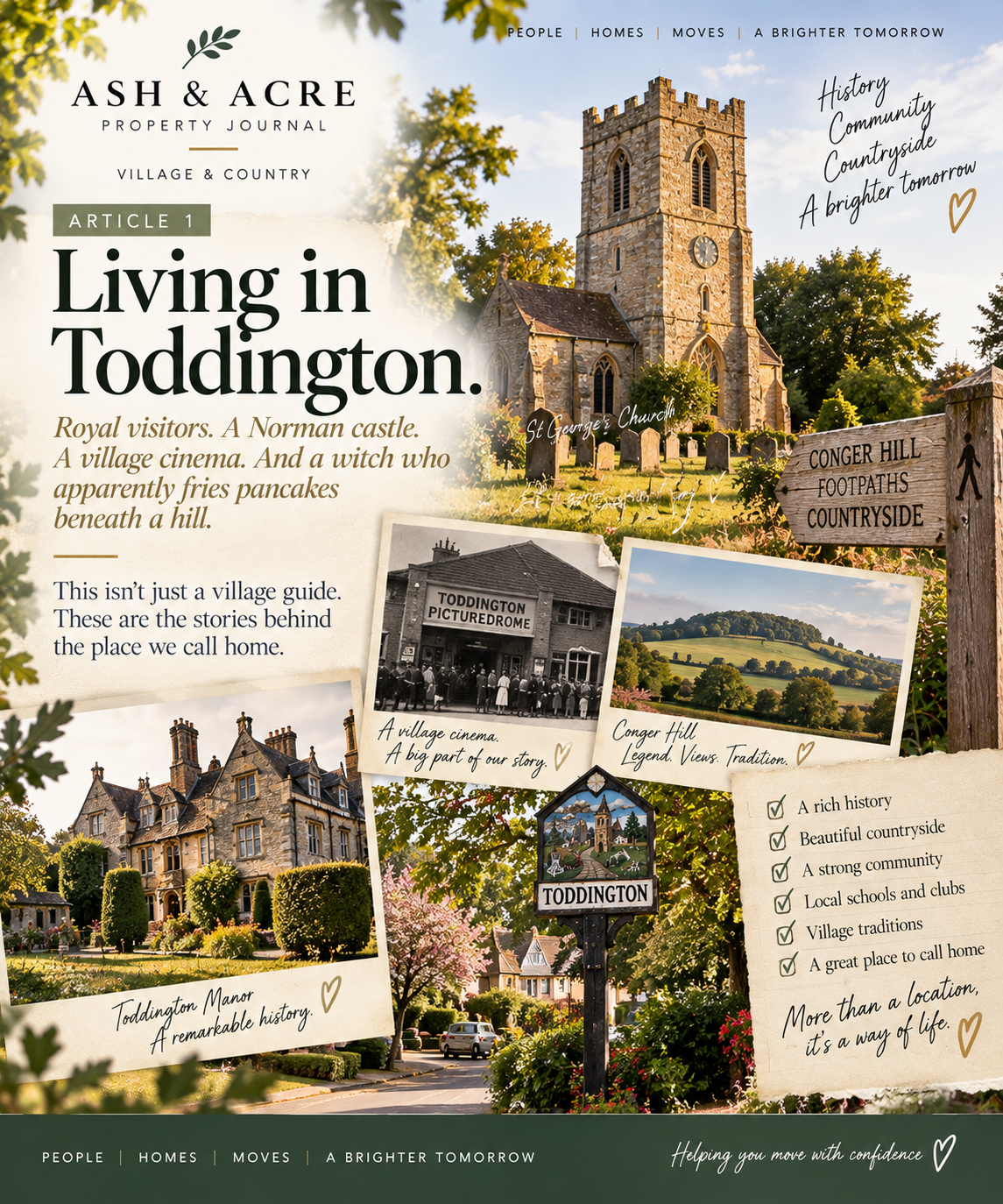
Toddington, for example, has walks around Crowbush, with footpaths leading through the surrounding countryside.
And it's precisely the sort of local knowledge that matters when you're choosing somewhere to live.
The portal can tell you how many bedrooms the house has.
It can't necessarily tell you where you'll be standing in your wellies at 7am with a Labrador who has suddenly developed a passionate interest in a hedge.
😂
That's part of understanding the life around the property, not just the property itself.
The floorplan matters to the dog too
You may look at a floorplan and see:
Kitchen.
Utility.
Sitting room.
Hallway.
The dog owner sees:
Wet-dog route.
🐾
If the only way into the garden is through the cream-carpeted sitting room, that's worth knowing.
Think about where a dog bed would go.
Where food and water bowls will live.
Where leads can be stored.
Whether there's somewhere quiet for your dog to settle.
And if you have more than one dog, consider whether there's enough space for them to have their own comfortable areas when they want them.
You don't need to buy a house designed around the dog.
Although we're reasonably certain Lottie and Araya would disagree.
But you do need the house to work for the whole household.
Bigger isn't always better
A huge garden can be wonderful.
But a smaller secure garden beside miles of good walking may suit your dog — and your lifestyle — considerably better.
Equally, an enormous rural property isn't automatically ideal if you have an older dog who struggles with stairs or needs easy access outside.
Think about the dog you actually have.
Their age.
Their mobility.
Their temperament.
Their routine.
Their needs may change over time too.
The dream isn't necessarily:
Biggest house + biggest garden.
It's:
The right home + the right location + the right everyday life.
Look beyond the property
When you're deciding where to live, think about the wider neighbourhood.
Is there a safe route for an evening walk?
How busy are the surrounding roads?
Where's the nearest useful green space?
What happens during school-run time?
Are there veterinary practices reasonably accessible?
What about groomers or doggy daycare if you use them?
And what happens locally throughout the year?
That last one is easily overlooked.
Village life occasionally gets loud
One of the lovely things about village life is the community events.
And Toddington has a particularly good example.
The local fire station has traditionally held a bonfire and fireworks event, bringing people together for one of those proper community evenings.
Wonderful if you're a human who enjoys fireworks.
Potentially somewhat less wonderful if you're a Labradoodle.
😂🐾
If you're new to an area, it's worth learning about regular local events — particularly if you have a dog who's frightened by loud noises.
On fireworks evenings, animal-welfare organisations generally recommend preparing in advance: exercise dogs earlier, keep them safely indoors during fireworks, close curtains or blinds to reduce flashes and provide a familiar, comfortable place where they can retreat.
And make sure doors, gates and boundaries are secure.
Wonderful for the community.
Slightly less popular with Lottie and Araya.
This is another little part of moving that doesn't appear on a floorplan.
But it's part of living somewhere.
Moving day needs a dog plan
Moving day is chaos.
Doors are open.
People are carrying furniture.
Boxes are everywhere.
Removal vans are arriving.
Everyone is asking where the kettle is.
And somewhere in the middle of this...
there's a dog.
This is one occasion where planning ahead is genuinely worthwhile.
Could your dog spend part of moving day with somebody they know?
If not, is there a secure, quiet room where they can stay safely while doors are being opened?
Keep familiar bedding, toys, food and water accessible rather than packing absolutely everything into the removal van.
And decide who is responsible for the dog.
Not vaguely.
Specifically.
Because:
“I thought you had Araya.”
is not the sentence anybody needs while standing between two houses with a removal van.
😂
Don't make everything new at once
Moving home is already a significant change for a dog.
New smells.
New rooms.
New noises.
New garden.
New walking routes.
New neighbours.
So familiar things can help.
That slightly battered dog bed you were planning to replace?
Perhaps don't replace it on moving day.
The blanket they've slept on for years?
Bring it.
Their usual bowls?
Bring them too.
A new house may feel exciting to us.
For a dog, familiar smells and routines can help the new environment start to feel like home.
Remember the boring admin
Once you've moved, don't forget to update your dog's microchip details with your new address and contact information.
It's exactly the sort of job that disappears underneath:
Unpack kitchen.
Find broadband router.
Build bed.
Locate school uniform.
Find missing box marked IMPORTANT.
😂
But put it on the moving list.
And while you're at it, make sure their ID tag and veterinary details are up to date where necessary too.
Take your time with the new neighbourhood
Even a dog with excellent recall is suddenly surrounded by unfamiliar smells, roads, paths and distractions after a move.
So don't feel you need to explore everything immediately.
Learn your new routes.
Understand where paths lead.
Notice where livestock is kept.
Find the safe places.
If appropriate for your dog, using a lead or long line while you're getting to know the area can give everybody a little more security.
There will be plenty of time for adventures.
Our dog-friendly second-viewing checklist
When you go back to a property you're seriously considering, ask yourself:
Is the garden genuinely secure?
Where will the dog sleep?
How do we get from the garden into the house when they're wet?
Where do the leads, towels and food go?
What's the everyday walk?
Are nearby roads safe for our normal routine?
Will stairs become a problem?
Can we get the dog comfortably into and out of the car?
Are there local events or surroundings we should know about?
And perhaps most importantly:
Does this work on an ordinary Wednesday — not just during a lovely viewing?
That's usually where the answer is.
Dogs don't care about granite worktops
This may be disappointing news if you've just spent £30,000 on your kitchen.
😂
But dogs don't care.
They don't care whether the bathroom tiles are fashionable.
They don't care whether the sitting room is south-facing.
And they're remarkably relaxed about whether the kitchen units are Farrow & Ball.
They care about their people.
Their routine.
Feeling safe.
Being comfortable.
And, in the case of our two, apparently knowing exactly when somebody opens the fridge from three rooms away.
So when you're looking for a new home, don't simply ask:
“Is this a dog-friendly house?”
Ask:
“Can we build a dog-friendly life here?”
That's the bigger question.
Find the home. Then find the life around it.
This is something you'll hear us say quite a lot at Ash & Acre.
A property isn't simply a collection of rooms.
It's the school run.
The commute.
The coffee shop.
The neighbour you wave to.
The Sunday walk.
The muddy boots by the back door.
The place the dog automatically waits when it's dinner time.
It's all the ordinary things that eventually turn an address into your home.
So yes, fall in love with the house.
But also walk the road.
Explore the village.
Find the footpaths.
Try the journey to work.
And if you've got a dog...
take a pair of wellies.
🐾❤️
Moving home with four-legged family members?
Tell us.
If you're looking for a home through Ash & Acre, we'll happily help you think beyond bedrooms and bathrooms and talk about the things that matter to your everyday life.
Amanda & Aiden Wright
Mother & Son · Co-Founders
Ask Amanda & Aiden →
Ask us about AVA →
Explore Homes For Sale →
And, of course:
Lottie & Araya
Dog-Friendly Property Consultants
Their advice is complimentary.
Their treats are not.
😂🐾
Ash & Acre · Family Run Estate Agents
Clarity. Confidence. Trust.